Barack Obama has taken on the role of chief booze peddler. Hoping to smooth over the controversy that has erupted over the arrest of Henry Louis Gates, the President has invited the professor and the arresting office to the White House for a beer. Given the professor's temper, is it really a good idea to get him all liquored up?
Henry Louis Gates is hardly the harmless professor the media is making him out to be. Frankly, Gates is to the Ivy League what Jeremiah Wright is to ecclesiastical circles.
At Harvard, Gates is the director of the W.E.B Du Bois Institute for African & African American Research, named after a known Communist. According to a WorldNetDaily profile of this academic subversive, Gates has lured other leftist rabble rousers to campus such as Cornel West and advocates Afrosupremacist positions such as Affirmative Action, reparations, and liberation theology. If one is known for the company one keeps, Americans should be very concerned about what they have let into the White House.
Michael Jackson wanted to be cloned by a UFO cult. According to Jackson's chauffer, the King of Pop became obsessed with creating a duplicate of himself after attending with Uri Geller a conference hosted by Clonaid. Clonaid is the research arm of the Raelians, a sect that believes human beings are the result of extraterrestrial genetic experimentation.
Life is apparently no circus for Ringling Brothers elephants. PETA operatives have obtained footage of handlers allegedly beating their pachyderms as a matter of course rather than when simply out of line.
Hopefully, some as intrepid videographer will capture footage of the mistreatment of animals known to go on at the hands of this animal welfare front group. It has been conjectured that PETA would rather see animals dead than in human hands.
Freedom of thought and descent have been dealt another blow during these days of the Obama regime. According to Joseph Farah of WorldNetDaily, search engines such as Google are quietly dropping or downplaying links to articles questioning the validity of Obama’s birth certificate.
Some will respond that, as private enterprises, search engines should be able to establish criteria as to what information they will present as legitimate. However, should such a perspective continue to expand, what makes these tactics any more moral than those employed in Communist China were access to certain viewpoints is blocked in the name of the good of the social order?
More importantly, how long will it be until not only access to websites questioning the government disappear but people as well? Certainly an awful lot of trouble to go to if our exalted Caliph has nothing to hide.
Many no doubt think that I have gone too far by insinuating that things may get to the point where those criticizing the government in general and Obama in particular might meet with, shall we say, expedited ends. However, the foundation is now being set to neutralize in an efficiently permanent manner one segment of the population no doubt seen as being an impediment to the kind of policies Obama represents.
Tucked away within the chapters of the Obama Healthcare Bill is a provision for “end of life counseling” referred to as “Advance Care Planning Consultation”. This clause requires the elderly to meet every five years with medical authorities to determine whether or not the individual’s life is worthy of continuation.
Supporters will insist that such an assessment is simply to clarify the patient’s preferences regarding these complicated matters. However, in light of statements made by Obama and a number of his closest advisors, one must ask will medical professionals simply implement the wishes of the patient or rather pressure the patient into complying with the prerogatives of social engineers.
For example, White House Healthcare Policy Advisor Ezekial Emanuel is said to believe that public resources would be better directed towards arts spending than extending the lives of the elderly. Likewise, Obama has suggested the elderly might be just as well off simply given pain medication rather than treatments that might actually improve their conditions.
At the heart of each position is a philosophy known as utilitarianism, which determines an individual’s worth based upon what they contribute or give back to the COMMUNITY. For example, illegal aliens are valuable and deserving of healthcare for their labor as near slaves. Sodomites are valuable to the state because of their deep pockets and for eroding traditional morality and religion.
Conversely, under such a system, it is in the state’s interest to quickly shuttle the elderly out of this life. This is for the following reasons.
For starters, since they are infirm, the elderly are unable to tangibly contribute to society’s perceived economic needs. However, more importantly, the radical statist feels an overwhelming need to eliminate the elderly since, for the most part, as a bloc they represent the greatest opposition to the totalitarian agenda.
Even though I am still a relatively young man, I remember several years back receiving a comment over something I had written where the commenter remarked that they were glad people like me were eventually dying out. Before it is all over with, don’t be surprised if the healthcare you end up receiving is proportionally linked to your support of an Obamaist agenda.
It is one thing to have fun at a wedding, but shouldn't one be a bit solemn when taking vows before God and man in a house of worship?
Since this exhibits the couple's degree of seriousness about getting married, I bet the marriage doesn't last more than two years.
No doubt there will be readers who say how dare I comment on people's private affairs; however, I must point out they are the ones that have put this ribaldary online for the world to gawk at.
So much for the diversity of opinion our exalted Caliph claims to support.
I wonder if a "certificate of live birth" would be enough for the paperwork the average American needs to acquire the magical documents we are assured will somehow stop terrorism.
So long as the bills are payed, the kids fed, and forty hours worked, what's so bad about some "escapism".
Isn't that especially true if the Christian has cautiously gone out of their way to ensure that their sensibilities and convictions will not be undermined through extraneous sex or violence?
In many ways, the so-called "real world" can be highly overrated.
These radio personalities should be reminded that not everyone has the same degree of career fulfillment that they have and that it is largely those of us stuck in tedious jobs that make financing air time possible.
If one wants to nitpick, maybe we should chastise those feigning sophistication by poopooing the Christian liteary ghetto for not making it in the realm of secular broadcasting.
In one of the climactic scenes of the conclusion of "Battlestar Galactica", Gaius Baltar remarks that an unseen hand had been guiding events all along up until that point. Just as the characters were propelled by something from beyond themselves, the producers behind this show may have been driven by ideas originating from sources other than their own fertile imaginations.
Even in the original "Battlestar Galactica" from the 1970's, one of the underlying premises of the saga was that "Life here began out there with forefathers of the Egyptians, the Toltecs, and the Mayans. There are some who say there may yet be brothers of man who fight somewhere to survive among the heavens." In the series finale of the contemporary retelling of the sci-fi classic, viewers got to see a bit of how this vision might have played out.
Though most can watch these compelling dramas unaware of the underlying worldviews of the authors and not be impacted by them to any appreciable degree, there is indeed a philosophy being presented that if nothing else impacts the authors' approach to the material at hand.
In the original with the narration provided by Patrick Macnee who went on to play a devil-like figure in that versions mildly Mormonesque mythos, one assumes that, when mankind arrived here on earth, there was no other intelligent life.
However, in the recently concluded version, we realize that it is prehistoric Earth (not even the actual Earth in the reimagining and if you add a third you'll have to have a crossover show with the Thundercats) that the Galactica fleet has arrived at.
To the casual viewer, either version does not seem all that different. It may comes as a surprise, therefore, that each depiction presents a slightly different viewpoint as to how civilization originated here on Earth.
In the original "Battlestar Galactica" with Earth being the home of the lost 13th tribe of man, it could be said that human life here is the result of an anthropocentric panspermia, meaning we came from elsewhere and are not native to this planet. This has a number of implications, especially for those embracing the perspective of Deep Ecology.
Going beyond a traditional environmentalist standpoint, Deep Ecology holds that mankind is an invasive species infesting the planet. As such, ripping it out through any means necessary including mass death is perfectly acceptable. Prince Phillip, whose primary accomplishment has been marrying someone else who never had to work a day n her life, basically wishes he could be reincarnated as a killer virus to wipe your family out because his own was a total drain on world resources.
The view taken by the new Galactica is much more complex and seems to ape (or at least hominid) so many other science fiction narratives these days that if one was a conspiracy theorist one might easily conclude that some kind of interplanetary catechism was trying to be conveyed to the masses. Once the Galactica fleet arrives, one sees a crouching survey team consisting of the shows primary characters such as Admiral Adama and Dr. Baltar.
These two proceed to banter back and forth about the odds of human life originating at two distinct places in the universe with Baltar remarking how the humans of the twelve colonies were genetically compatible with those there on this planet that would come to be known as Earth. It was also noted how these humanoids had not yet developed language and how the new arrivals could bestow this rudiment of civilization upon their less-developed counterparts.
Thus, in this version of "Battlestar Galactica", the scenario presented is closer to that of the "Chariots Of The Gods" hypothesis. According to that theory, culture and technology were not developed over time by earth's native inhabitants but rather something bestowed upon us by an advanced civilization "from beyond the heavens".
Even more interesting, in the final scene of the series, the bottom of the screen flashes "150,000 years in the future". We then see the "angelic" versions of Six and Baltar reading a National Geographic article over the shoulder of producer Brian Moore about "Mitochondrial Eve", the earliest known ancestor from whom all human beings can trace our ancestry. Discussing the article between themselves, Baltar and Six reveal that the human race walking this earth today is actually a hybrid one the result of interbreeding between humans and genetically engineered Cylon synthoids.
A number in the viewing audience will conclude what an imaginative way to resolve the destructive Human/Cylon conflict with both sides getting what they want as prophesied with each of these civilizations being saved or continued through the hybrid child Hera. However, those more attuned to these messages will notice that this theme of human-”extraterrestrial” amalgamation has shown up in so many examples of speculative fiction the past few years that one would almost say it was cliché if it did not serve some higher propaganda purpose.
Just think, 20 odd years from now, if America is still around there will likely be a President shaking hands and brown-nosing Bin Laden.
Sound outrageous, just look at the picture above.
For those with little historical perspective, the man above was at one time the Bin Ladin of that era (the one on the left. the one to the right is working on his legacy of infamy).
Some will no doubt object to this use of language, but if this is the mindset of Afrosupremacists seizing power and demanding handouts, it is my patriotic duty to make sure the world knows the ugly truth. After all, a mere "you people" from the lips of Ross Perot lost him the 1992 presidential race.
Unless this bag has some super-secret James Bond-style tricks it can do, I don't want to hear one more word from this hag about public service, sacrifice, and giving back to the COMMUNITY.
Had this student been wearing a shirt extolling Afro or Hispanosupremacism she would not have been physically accosted but rather likely applauded and given an award.
With the passing of Jerry Falwell and D. James Kennedy along with the dissolution of the Center for Reclaiming America and the Center for Christian Statesmanship, the issue has arisen once again as to whether or not conservative Evangelicals should participate in political activity. Since things have not gotten any better and if anything continued their downward spiral since the advent of the contemporary conservative Evangelical movement popularly referred to as the "Religious Right", it has been suggested by some that politically interested Christians should be herded back into their pews to once again await the Apocalypse.
Interestingly, one of the foremost voices now opposed to conservative Evangelical political involvement is none other than columnist Cal Thomas, who at one time served as a Falwell underling as vice president of Moral Majority and spoke at Dr. Kennedy's Reclaiming America for Christ conference. Thomas, in a column analyzing the passing of his former colleague titled "The Legacy of Jerry Falwell", concludes of the Religious Right, "The movement also had its downside, because it tended to detract from a Christian's primary responsibility of telling people the 'good news' that redemption comes only through Jesus Christ."
While there is a degree of truth to that as during the early to mid 90's at times it seemed Falwell's ministry did place too much emphasis hawking videotapes exposing the criminality of Bill Clinton and replaying week after week snippets of homosexual excesses to the point where one had to send children out of the room or have to explain why mommy and daddy's faces were turning red, some of this is more the fault of how the Evangelical subculture is structured sociologically than the result of Christian political participation per say.
All throughout Sunday school and the Christian day school environment, those spending most of their lives in this branch of the Christian faith are conditioned with the assumption that those holding professional ministry positions such as pastors and missionaries are some how a cut above the remainder of the congregation even though the traditional Protestant position held to the priesthood of all believers and that all moral work was as equally holy. As such, it is no wonder most believers are paralyzed unless there is a so-called "man of the cloth" there on the scene to direct their every movement. Thus, it was only natural that clergy such as Falwell and Kennedy would have to play prominent roles in these movements.
Ironically, at earlier stages in his career, Thomas was one of the most eloquent voices urging Christian youth to consider callings in fields other than professional ministry such as government, politics, and the media. He even one time quipped he did not recall any Christian being called to serve Christ part time.
However, now that he's had his career, Thomas concludes that "...a Christian's primary responsibility is telling people the 'good news' that redemption comes only through Jesus Christ." If that's the case, is Thomas going to repose himself from commenting on sociopolitical matters in favor of more monastic or missional undertakings or is it part of a more natural inclination of not wanting to share notoriety.
For in another column Thomas lamented the rise of consumer choice as exemplified by the growth of talk radio and the blogosphere and instead enunciated a preference that the masses all sup of the same information from the swill placed before them by traditional journalists as the nation's media gatekeepers.
When Thomas chastises Christians for participating in politics and the media since this detracts from time that should be spent directly sharing the Gospel, is he also going to level this charge against Christian physicians if they take the time to perform surgery rather than only praying for the patient's recovery? Likewise, what about the farmer that toils away all day in their fields as this is also time that could be spent in more religious pursuits.
I Corinthians 12:28 says to some God gave to be preachers, some evangelists, others government. Not everyone is cut out for the same purpose in life. As such, their level of interest and the way they contribute to the advancement of the Kingdom of God will varying by kind and degree.
Thomas writes, "But Christians must first understand that the issues they most care about --- abortion, same-sex marriage, and cultural rot --- are not caused by bad politics, but are matters of the heart and soul." While Thomas is correct that these problems won't ultimately be solved until people have a total renewing of the mind found through Christ's shed blood, it does not follow nothing else should be done to ameliorate the social impacts of these manifestations of man’s sin nature.
All it takes for evil to win is for good men to do nothing. In certain communities across the United States, whether or not I steal your car at a stoplight, plug your head with a bullet, and rape your mother as you lay their bleeding to death there on the pavement are as debated as the propriety of abortion and sodomite nuptials are in others. Does that mean in such jurisdictions those of good conscience should not insist that laws against these infractions should not be enforced since, well, the unrepentant apparently have few qualms or taboos against such alternative lifestyle choices?
The tendency of the human species is to take things to extremes. Luther remarked that man is like a drunkard banging his head into one wall and then the next. Granted, many believers have come to expect too much from politics as David Frum has remarked that the debate is no longer about reducing the size of government but rather about divvying up the fiscal spoils.
Many Christians probably did become dupes of the Republican Party at one point. Frankly, though, where else were they going to go?
At least the GOP would consider individualism construed through the prism of a Christian worldview. The Democratic Party has pretty much given itself over to debauchery and collectivism. If one tries really really hard one can count the number of worthwhile Democrats such as Zel Miller on one hand.
Though some Christians are loathe to admit it as they have been conditioned by overly pacifistic interpretation of passages such as turn the other cheek, sometimes Christian involvement is not about bringing the reprobates to a saving knowledge of Christ as fundamental and essential as that mission is. Rather it is about keeping these ravenous jackals away from you and what is rightfully yours.
Some might respond “But didn’t Jesus say to give them your cloak?” My friends, these blatant communalists want more than the shirt off your back. For they will stop at nothing until they not only have the souls of you and your children, but also the very house that you live in and the automobile that you drive if we adhere to the recommendations of the radical pietists if we as believers refrain from political matters such as property rights and environmental policy.
And if some preacher gets up there and blabbers on about how these are just material things we should give up willy nilly, see if he ever forgets to pass the collection plate or how antsy he gets when the IRS considers tweeking something in its code not even remotely related to the survival of religious liberty in this country such as exemptions on pastoral housing allowances. If the rest of us get hosed by revenuers, why not the clergy as well? Maybe then they won’t be so quick to bend their knee before the state’s Baphomet.
While some such as Cal Thomas seem to counsel disinvolvement from sociopolitical activism out of a sincere desire to retain doctrinal purity and separation, others embodying what in Fundamentalist circles is known as Neo-Evangelicalism do so for other reasons. Seeking to get along with other theologies for the sake of getting along, this perspective is endeavoring to take hypertolerance and unity to a whole new level even if it means downplaying or overlooking some of Scripture's most obvious mandates.
Ironically, though the word “mandate” means something else, one of the issues the Christian in the pews is being urged to keep quiet about is none other than “man dates”. For in the March/April 2007 issue of The Plain Truth Magazine, in the article “I Kissed Religion Goodbye”, Greg Albrecht lists as one of his complaints is that many churches expect members to “Vote and politically agitate in absolute, lockstep with pro-life and anti-homosexual views exactly the way your church promotes and endorses them”.
Unlike the war against terror over which sincere Christians can have differing interpretations as to how to best approach the issue, there is not much wiggle room there as to abortion and homosexuality. There is not really anyway around “Thou shalt not murder” and injunctions against carnal relations with members of the same sex unless Albrecht wants to come out and say that the unborn really aren’t human beings and that God did not create marriage to be between a man and a woman.
To many, these issues probably do seem to attract an inordinate amount of attention from conservative Evangelicals. But whose fault is that?
Would most believers even give buggery all that much thought if the gay rights movement was simply about what one did in the privacy of one's home. Seems to me, activist gays are the ones trying to get up in everyone's business as they attempt to penetrate the media, education, and now even ecclesiastical institutions.
Though opposition to such perversities should not become the sole focus of any balanced ministry as Christ died for these individuals also and one wants to avoid becoming unhinged like the Fred Phelps cult, if the churches of America are not going to stand up for the traditional family and marriage as being between a man and woman as the only legitimate form of marriage out of fear of whom they might offend, then they might as well empty the baptismal font and close up shop. For if they do deny the true nature of these fundamental human relationships, it won't be long until the true nature of the God that instituted them will be denied as well.
In the opening of his article, Albrecht laments the "mudslinging and negative rhetoric that ridiculed 'Democrats' and lavished unadulterated praise on all things Republican." Of this, the discerning Christian must ask was this an outright political endorsement of a particular candidate or party (as today I have a hard time imaging there are that many pastors with that much of a spine left willing to jeopardize their tax exempt status as a friend relayed to me how he was pressured to drop the word "liberal" from an article written for the newsletter of what is suppose to be an Independent Baptist Church).
If believers and churches can no longer mention in a nonpartisan context where the Christian faith lines up with the conservative Republican agenda nor condemn those things traditionally thought of as being more liberal Democrat in nature, how much longer until we are counseled by those whose fortunes and notoriety are derived from holding lucrative positions of ecclesiastical leadership to downplay more fundamental aspects of the Christian faith. Already, operatives of Rev. Moon have convinced a number of churches to remove crosses. Those caving so easily will no doubt next downplay the need to be saved from our sins and eventually the need for Jesus as Lord and Savior all together.
However, don't think Albrecht is calling for the complete expunging of politics from the socio-ecclesiastical enterprise all together. For the influence he would see taken out of the hands of conservatives, he gladly places in the hands of more liberal causes.
In a bullet point list of what he perceives as the errors of more conservative or traditional congregations, Albrecht writes in a flippant attempt at humor, "Don't worry about the environment, the poor, or global warming --- those liberal, do-gooder churches have programs for those kinds of things."
What Albrecht is criticizing here are believers who do not necessarily think spending more money and who do not think more government intervention into our lives is going to solve certain problems, that things are as bad as elites would have us believe, or think that people do not necessarily bear some responsibility for their own problems.
As to the poor, it has been my experience that often the most conservative or Fundamentalist of churches of the "old school" variety probably spend larger percentages of their overall incomes on missions and outreach to the individual poor in their immediate vicinity than more leftist evangelical and mainline churches that probably spend a greater percentage on making sure everyone else sees what they are supposedly doing for the poor.
As to the environment and global warming, frankly the jury is still out on this issue as to the following reasons. (1) Does global warming actually exist? (2) If it does, what is its exact cause? So by edicts handed down from on high without these questions being answered, does this mean the average person should forfeit much of their physical mobility just because of some whim of someone further up the bureaucratic hierarchy?
Of course, such restrictions do not apply to the self-appointed such as Greg Albrecht since such figures are so much more important than the rest of us as we Neanderthals would be lost without such guidance.
As to both the environment and poverty, it is questionable that mass scale approaches are the best approach for solving these issues. Often the aide sent to Africans ends up hindering their plight.
Likewise, the best way to save the environment is not by necessarily cordoning it off necessarily into untouchable preserves and by regulating the life out of property to the point where one cannot do anything with it as most sane people tend to care for something best when they are the ones that own it and have the largest say in how it is used.
While no Christian in his right mind advocates dirty water, to a growing number of Evangelicals this concern for the environment goes beyond keeping trash off the shoulder of the highway. Though I cannot speak to Greg Albrecht's views on the afterlife, from one of the snippy remarks made in his sarcastic bullet points one could come away with the impression that he is trodding dangerously close to embracing some of the assumptions of the Emergent Church crowd that the Kingdom of God is not so much a promise of a new heaven and a new earth but the continuation of this one in its current state. Frankly, if this world is all we've got, Christianity is a big waste of time and those snookered into it deserve a refund.
The hyperpious might begin to hyperventilate at such a bold proclamation; however, it is essentially a Biblical sentiment. I Corinthians 15:19 says, “If in this life only we have hope in Christ, we are of all men most miserable.”
One can deduce that Albrecht and those of like mind in the Emergent, Purpose Driven, and Church Growth movements don't place all that much importance upon the afterlife. For while certain eras of Church History such as the Middle Ages often placed too much emphasis on what comes next, these contemporary theologies don't emphasize it nearly enough.
In his tongue-in-cheek bullet points, Albrecht writes, "You need to believe in the hottest hell with billions being tortured. And you need to believe in the Rapture, the time when members of your church (at least those who are in good standing) escape hell on earth. Some call this time 'The Tribulation' --- a time when so many who richly deserve it will 'get their's'."
Sincere souls can disagree about the sequence of some of these foretold events. However, what they cannot do is deny that one day there will be some kind of ultimate accounting.
Though it has changed considerably, as a leader in the Worldwide Church Of God, frankly, Albrecht ought to be the last one to criticize an interest in eschatology as his sect or denomination was at one time infamous for their obsession with the topic. But like a former glutton that has lost all kinds of weight now telling everyone else that they eat too much, Albrect condemns as a fanatic anyone daring to suggest that there is an eerily increasing similarity between certain portions of Scripture such as Daniel, Thessalonians, and Revelation and certain political and technological developments.
Often those that run in Emergent Church circles foment the assumption that the image of a God of justice and wrath is somehow at odds with the image of God as a God of love. It is because He is a God of love and mercy that He must also be a God of justice and wrath.
The prospect of no eternal punishment for those outside the parameters by which God allows men to be saved (namely believing that one's own good is insufficient to accomplish this and only belief in the Lord Jesus Christ is going to get one to the Pearly Gates) in fact actually tarnishes those gates and makes the streets of Heaven all the more dim. For if God ends up letting anyone in irrespective of whether or not they are sorry for what they did even though God was willing to go to the extent of sacrificing His only begotten Son in order to make a spot for them with Him in eternity, that would make for a very weak God.
Though we as human beings have an innate tendency to avoid pain at all costs even if it means denying its existence, that does not eliminate it if we are unwilling to take the necessary steps. For example, if someone diagnosed with a horrible disease simply decides to say the disease of an uneducated and overactive imagination, that is not going to prevent it from ravaging the patient's body.
Then why do Modernist, Postmodernist, and Emergent theologians waltzing along the ledges of apostasy keep thinking that wishing away Hell's flames is going to make them any cooler? It has been estimated that Jesus spoke more about Hell than He did heaven; therefore, if we are to say that on this matter He is just plain wrong, then why are we to turn around and assume He's anymore correct about Heaven, His coming kingdom, or even the forgiveness of sins?
As to whether or not some Christians are vindictive about Hell has no bearing as to its existence. To say that it does is akin to saying the police department should be abolished entirely and criminals allowed to pillage through the streets simply because a few officers have abused the powers that have been vested in them.
It is only because the most orthodox of Christians believe that Hell as an actual place of torment exists that it seems to play such a prominent role in conservative theologies of varying stripes. While as fallen human beings it is easy from time to time for our anger to get the best of us and to wish someone to that dreaded realm that has ticked us off, those on the right side of the theological continuum do not emphasize the reality of Hell out of some perverse desire to see the unrepentant tossed into the Abyss but rather so that the greatest number might be able to avoid this destination of unimaginable torment.
Thus in recap, among Evangelicals such as Albrecht wanting to look cool in the eyes of the world, Heaven is downplayed in favor of a utopian kingdom. Relatedly, Hell is downplayed for fear of casting bad PR on a loving God and because it makes the unbelieving uncomfortable. Kind of makes you wonder the point of giving one's life to Christ if some saintly grandmother that loved the Lord her entire life is going to endure the same fate as Adolf Hitler or Joseph Stalin since it is highly doubtful these genocidal reprobates pleaded for mercy on the Blood of Christ before leaving this world.
Over the past few decades, at times Evangelicals have taken political activism to extents that can understandably cause concern among the discerning. However, to disengage to the extent some now suggest would also prove equally disastrous.
In this audio link, Albert Mohler's sidekick Russell Moore examines the propriety of Christians celebrating the Fourth of July.
While it is always good to keep government in its proper place in one's heart and mind, I wonder if he is also going to have the backbone to also proclaim that the COMMUNITY is not an independent source of authority or to stand against the spineless pandering to Hispanics that is going on in many of the nation's churches.
In some congregations, this separatism is applauded to such an extent that Hispanics are permitted to establish semi-independent subcongregations and encouraged to retain their old identities while the Americans in the primary congregation are condemned for thinking the United States is a cut above other countries or for not flinging the gates wide-open to unrestricted immigration that doesn't take into account whether or not those swarming here want to be a part of this nation, merely to suck off our resources as welfare parasites, or to engage in activities of a far more subversive nature.
In his comments, Moore criticizes "The American Patriot's Study Bible". While such an edition of God's Word might be going a step too far, where was Moore on the issue of the "Kwanzaa Study Bible" and the edition of the Bible bound in the colors of the Pan-African flag that I exposed in my column Radical Interpretation.?
In his comments, Russell makes a number of observations worthy of comment. Foremost of these is how many of the complaints against patriotic services are leveled by the young who do not want to sing tunes such as "Mine Eyes Have Seen The Glory", commonly referred to as "The Battle Hymn Of The Republic".
Most of these twits would rather sing those banalities where the same line of content so miniscule that it barely rises to the level of doctrine over and over at least a dozen times.
More importantly, I must posit that opposition to this particular song is not raised in honor of the Confederate cause or even because it over glorifies the United States.
Rather, if one digs deep enough, most that despise this song no doubt do so because it mentions the coming of the Lord, a teaching most of those bashing traditional Christianity --- be they of the Emergent Church or more mainline denominations --- either downplay or abandon all together.
As a mere pop music entertainer, it is doubtful that Jamie Foxx comprehends anything as nearly complex as the Ottoman millett system.
However, a contemporary version of it is exactly what he is endorsing when he said of Michael Jackson "We want to celebate this black man. He belongs to us and we shared him with everyone else."
In the millett system, the person was subject to distinct laws and customs specific to the confessional community to which one belonged rather than the laws of the empire solely.
So in essense, one is not an Amerian first and foremost or even one's own individual but rather you belong primarily to the racial group or more specifically the hucksters that have set themselves up as its leaders.
Just a quick look at the kinds of people behind this Emergent Churh, communitarian nonsense.
I don't believe the North African dictatorship is mentioned in the above article, but it is mentioned in this link.
If these false prophets wanted to make a break with the past, why wouldn't they disband the group all together and not even have the name of David Moses Berg on affiliated with their ministry.
Is akin to trying to rehabilitate the People's Temple and claim Jim Jones was a good guy deep down despite going off the deep end.
In this story about the debate of whether chimpanznees or orangutans are humanity's closest relative it concludes with a very revealing statement: "In other words, if the DNA evidence that many biologists use as evidence turned out not to accurately reveal evolutionary relationships, the work of many molecular biologists would be suspect. If this was true, we would lose entire departments at major universities, Disotell said.'I would have nothing to do. I would go become a carpenter'."
To those that are now going to go into vapors over what Boehner said, the word he used is all you are going to have left to eat and keep you warm if Obama's "Climate Change" bill is enacted.
Too bad the media did not go into 24 hour coverage over this usurpation of American living standards rather than Michael Jackson's passing, which though sad, won't really impact your own life by the time winter heating bills arrive in the mail.
Wonder if educators would have rallied to the cause of free speech if students had instead decided to include a panel depicting a cross or the words "Jesus Saves".
A state-sponsored pregnancy prevention program at the University of North Carolina is paying girls $1.00 a day not to get pregnant.
Since it takes two to make a baby, shouldn't young men be getting this WELFARE also?
If it was reversed, wouldn't NOW nags be crying discrimination?
Some will argue there really isn't anyway to prove boys are complying with the program.
But the same is true with girls up until the time they either have the baby or one notices the bulge in the belly.
So, when this happens, will program administrators subtract back to around the time when the contract was broken and demand any compensation from that point forward be returned to the program's coffers?
How about, instead of handing out money, scaring both boys and girls into keeping their pants on and legs together by emphasizing what will happen to them should they catch an incurable disease or the hardship that will result from having a baby before they get married?
Contrary to the headshrinkers, fear can be a good motivator.
If two men are shacked up together in abomination, why can't they both get their own insurance from their respective employers?
Benefits are extended to married couples because traditionally the woman labored in the home as a domestic engineer and childrearing specialist.
Since those of warped affections cannot reproduce, there is no reason to extend these privileges to them and drive up the costs for those living as God intended in either holy matrimony or celebate singlehood.
Wonder if the punishment would have been as harsh if the kiss was directed towards a gay lover.
Officials claim they were enforcing the rules.
Thus, I guess it was more about failing an individual for exhibiting insufficient loyalty to the state since the gesture of a kiss of gratitude towards a parent in defiance of an arbitrary decree would prove the individual's higher devotion was to the family rather than the government.
The human mind and spirit cannot endure for very long the chaotic vacillation of such lawlessness before the individual eventually cries out for answers to the extremes of licentiousness and total control. Throughout much of the Modern Era, the Christian apologist could appeal to a shared respect for historic and scientific fact common to both Christianity and commonsense realism. Today, the Christian must first reestablish why anyone ought to believe in anything at all and then assert how the Biblical approach provides the best possible explanation for the condition in which man actually finds himself and the facts as they are rather than how he might like them to be.
The apologist must begin this process by exposing the intellectual and moral bankruptcy of the Postmodernist system. James Sire writes in The Universe Next Door, "If we hold that all linguistic utterances are power plays, then that utterance itself is a power play and no more likely to be more proper than any other (187)."
This claim by Postmodernists that all utterances are merely power plays fails the test of systematic consistency where a philosophical proposition must square with the external world as well as logically cohere with the other statements comprising the set of beliefs under consideration. But more important than the sense of satisfaction resulting from the discovery of this contradiction allowing for a degree of one-upmanship in the battle of ideas is the realization that this contradiction exposes the unlivability of a particular worldview.
Big deal, the Postmodernist might quip in response to this inconsistency since they are not known for their devotion to logical argumentation. Try as they might to gloss over this oversight with platitudes honoring the glories of relativism and tolerance, Postmodernists still deep down possess that human yearning for a universal justice. Romans 2:14-15 says, "Indeed, when Gentiles, who do not have the law, do by nature things required by the law, they are a law for themselves, even though they do not have the law, since they show that the requirements of the law are written on their hearts..."
It might not be fashionable to contend that there is no such thing as right and wrong and often believing such is even an occupational requirement in certain academic and governmental circles. But when it comes down to it, no one really wants to be treated as if that was the case. C.S. Lewis was fond of noting that those among us preaching the loudest in favor of relativism would cry bloody murder just like the rest of us if egregiously wronged. Just see what happens the next time the faculty nihilist is denied tenure when up for review.
Once it is established by our own existential makeup that there is something to right and wrong beyond the whims of those strong enough to have their way with the weak, it needs to be highlighted where these standards come from. John Frame in Apologetics To The Glory Of God writes, "Now, where does this authority of the absolute moral principle come from? Ultimately, only two kinds of answers are possible: the source of absolute moral authority is either personal or impersonal (97)."
This means that the ethical framework of the universe either arose within its own structure on its own or through the conscientious ordering of a higher organizing mind. Since we ourselves possess consciousness, by default the source of this moral order would have to be aware since it is impossible for the unaware to give rise to the aware or even to establish an ordered universe since that which is not guided and directed is haphazard and random.
If the Christian has been successful up to this point, the Christian has aided the Postmodernist in realizing that there is purpose and direction in life. The next step in the process involved proving to the Postmodernist that the Christian faith is the correct system of thought and meaning. Now the Christian can reintroduce a more traditional apologetic since the Postmodernist is now capable of stomaching objective fact.
The task of the Christian Apologist is to show the unbeliever that the Christian faith is the most viable religious option. This is accomplished by emphasizing the validity of the Biblical account. The first hurdle to overcome regards the historical legitimacy of the Gospel records. To accomplish, Winfried Corduan provides the following checklist of questions in No Doubt About It: The Case For Christianity: "(1) Are the accounts written by people closely associated with the event? (2) Are our present versions of the Gospels what the original authors wrote? (3) Are the accounts so biased as to be unbelievable? (4) Do the accounts contain impossibilities (186)?"
By answering these questions, it is discovered that the Gospels are remarkably well off. The Gospels are themselves written by eyewitnesses or contain the testimony of eyewitnesses. Corduan writes, "Matthew and John were disciples...Mark was a native of Jerusalem and present at the Gospel events...and reported the reminisces of Peter. Luke...was not a disciple...Yet tells of the research he did (189)."
Regarding the quality of the Gospel manuscripts, so many have come down to us in the present day with so few variant readings that there is little chance of some textual huckster committing documentary fraud without someone catching wind of it. As to the matter of bias, while the Gospels and the Bible were written to advance a certain perspective the same as any other book, it is remarkably blunt in cataloging the shortcomings of its most beloved protagonists. Most memoirs and autobiographies go out of their way to cast their subjects in the most favorable light possible even at the expense of factual accuracy.
Lastly, as to whether or not the Gospels record impossibilities is a matter of preconception in the mind of the beholder. One can either maintain the Humean notion that miracles do not occur because miracles do not occur or abide by the canons of historical research and accept these extraordinary events as they come since the rest of the document passes muster.
Since the Gospels are deemed as historically reliable, it would follow that those studying these document should look to those spoken thereof in its pages to provided the content and meaning of these events addressed. After all, the Founding Fathers are still looked to as important sources for interpreting the U.S. Constitution and for what was intended for the early American republic.
Likewise, to comprehend fully the significance of Jesus, the sincere student of history ought to consider what this historical figure said about himself. Jesus says in Matthew 12:39-40, "A wicked and adulterous generation asks for a miraculous sign. But none will be given except for the prophet Jonah. For as Jonah was three days and three nights in the belly of a huge fish, so the Son of Man will be three days and nights in the heart of the earth." From later passages detailing the Resurrection, we see that he carried through on this promise.
In Matthew 16:13-17, Jesus asks His disciples who they think He is. Peter responds, "You are the Christ, the Son of the Living God." Jesus did not chastise Peter for idolatry; instead he ratified the Apostle's assertion by replying, "Blessed are you, Simeon son of Jonah, for this was not revealed to you by man, but by my Father in heaven."
An apologetic designed to address the concerns raised by Postmodernism presents a number of possibilities as well as challenges to the Christian seeking to reach those trapped by this subtle but pervasive mindset. Crafting an apologetic addressing the spirit of the age to an extent makes the evangelistic task somewhat easier.
Postmodernism already wrests asunder most metaphysical pretensions as linguistic obfuscations protecting the powerful. Therefore, the Postmodernist has already done a portion of the Christian’s work by exposing the invalidity of most intellectual systems. The Christian can therefore rush in and expose the contradictory nature of outright nihilism without first having to tear down incorrect theologies and the faulty ethics arising from them. As a result, the Christian can then show how the alternatives found in the Bible strike the proper balance between the liberation and conformity tearing at the heart of contemporary culture and individual well-being.
However, these characteristics can also serve as drawbacks when employing an apologetic addressing Postmodernism. Even though the Apologist does not have to deconstruct (to use a term popular in Postmodernist circles) faulty conceptions of God when dealing with these thinkers, the Christian has to take the time to reestablish why anything matters at all. With those hovering around the periphery, it might be relatively easy to lure them back onto the solid ground of commonsense founded on Christian absolutes; however, those at the heart of this movement churning out its lies and deceptions will be considerably harder to convince and will continue to ensnare unreflective minds.
It is in the campaign against this ongoing subversion that the Christian waging a defensive action to preserve the remaining shreds of moral sanity can get bogged down and neglect the distinctives of the Christian faith in favor of a less offensive set of principles common to various religions and ideologies shocked by the ethical brutality of the contemporary era.
Of the crop of books over the past few years by figures such as Bill Benet, Robert Bork, and James Q. Wilson that bemoan the decline in social morality, Hugh Hewitt writes in The Embarrassed Believer: Reviving Christian Witness In An Age Of Unbelief, “But there is no apologetic content to these writings. And they are mute on the ultimate question, they are ineffective. In fact, they might actually be harmful (154).” The Christian accomplishes little of lasting impact if the message is watered down to attract allies or spends inordinate amounts of time addressing the symptoms of the disease rather than the cause.
Ephesians 6:12 says, “For we wrestle not against flesh and blood, but against principalities and powers, against spiritual darkness in high places.” The Christian is involved in a grand spiritual conflict all around him. As in all wars, weapons and tactics change over time as each side engages in a spiraling exchange of point/counterpoint as each side tries to best the other.
In the Modern era, the Christian utilized an apologetic appealing to a common respect for objective factual knowledge shared with the broader culture. However, in the change to Postmodernism, the Christian has had to alter the apologetic to show how life without objective truth is unlivable. From that point the Apologist can go on to show how what Francis Schaeffer termed “true truth” indelibly points towards Christ.
And some of you no doubt think I overreact when I call him "De Fuehrer". All I have to say is if this is an accurate reflection of his mindset, you better learn to say "SIEGGGGGGGGGG HEILLLLLLLL!!!! SIEG HEILLLLLLLLLLL!!!"
Nothing, but I am not the one that delivered a campaign speech condemning Americans for "eating what we want, riding around in SUV's, and keeping homes at 70 degrees".
Since this kind of outing has no bearing whatsover on national security concerns, shouldn't the Obama's sit their rearends at home like everybody else?
A site perhaps even more frightening than the alien pictured below.
Wonders if he'd be so tough without his body guards or likely living in a gated community.
The naive forecaster claims he merely wanted to share the experience he thinks all Americans should be compelled to take part in.
However, if those like him are going to wantonly broadcast the identities of jurors for criminals and their associates to see, why ought Americans step forward to fulfill this civic obligation?
And if others are going to make the case that posting such photos is part of their First Amendment Rights, I hope they are just as vigorous in defending Second Amendment Rights by expanding concealed weapons permits so those forced to serve on juries can then protect themselves.
Yet any other time De Fuehrer goes out of his way to insist that America is not a Christian nation and goes to great lenghts to avoid hearing the name of Jesus.
The response was in regards to a queston pertaining to gay marriage, however, the former Vice President's exact words were "I think people ought to be free to enter into any kind of union they wish, any kind of arrangement they wish."
Under such a banner, society would be required to sanction polygamy between consenting adults as, contrary to popular perception, not all such unconventional households consist of a preteen being paired off with a sixty-year-old.
Thought this cover of the New Yorker sparked the imagination.
Glancing at it sends the mind spinning in so many directions.
Is it a statement that the printed word will outlast computers?
You will notice that the technologically sophisticated alien has a book in hand while reading amidst electronic refuse such as discarded keyboards and CD's.
Also, one imagines is the alien here as a conqueror or come to study us as an archeological subject long after we have departed as the buildings his saucer hovers over look worn down and decayed.
Is that from attack or the passage of the centuries?
I hope this does not include the military versions of these vehicles.
As some may recall, it was Arnold Schwarzenegger, who now tells you how to live in the name of the environment, that got the manufacturer to produce these vehicles for the consumer sector.
Is it really wise to have our greatest potential enemy to be producing these?
One must condemn both incidents. However, interesting isn't it, how the murder of the baby butcher ranks top billing among headlines and is being blamed on Fox News for daring to do a report on him whereas very little is being reported about the killing of two soliders in front of a recruiting station by a fanatical Muslim?
Some are no doubt growing weary of my constant drumbeat of Obama's campaign quote lamenting America's eating what we want, driving SUV's, and keeping our homes heated at 70 degrees. However, I am not going to let this one slide until De Fuehrer starts living by the same spirit of sacrifice he is demanding from the remainder of us.
One might say the future is here --- and we might want to send it back for a refund. Having waited years and wondering at times whether mankind would even survive to see the day, the world now finds itself on the other side of a new millennium. In some ways, it is everything optimistic futurists dreamed of in terms of faster modes of transportation, improved forms of medicine and almost instantaneous global communication. However, one would hardly consider it the quaint but technologically sophisticated world of George Jetson whose most formidable challenges consisted of navigating Mr. Spacely's fickle temper and making sure Rosie the robot maid stayed adequately oiled. Instead, inhabitants of the early twenty-first century worry if their children will even return home alive from school in the evening or how much longer they have until turbaned fanatics turn the accumulated glories of Western civilization into a smoldering atomic wasteland.
Somewhere along the highway leading from intentions to actuality society seems to have taken a wrong turn and gotten lost along the way. When finding oneself in unintended surroundings while road-tripping across the country, one pulls over to the shoulder of the road to look at a map to determine where one's navigation went astray. Likewise, when a culture begins to display signs of being out of kilter, the time has come to examine the sociological roadmap in terms of the philosophies, beliefs, and ideas individuals use to live their lives and those in authority employ to oversee events.
The observer of intellectual trends might note the contradictory nature of today's philosophical scene. For while proponents of the status quo purport to be characterized by a considerable latitude of conscience, such professed flexibility ultimately turns back on itself and bears down harshly upon any dissident daring to question the system's most cherished assumptions. The prevailing outlook can be characterized as a pragmatic Postmodernism.
Postmodernism can be looked at as a worldview holding that truth as an objective overarching reality does not exist and is instead a subjective linguistic or conceptual construct adopted by an individual or group for the purposes of coping with existence. As such, no single explanatory narrative is superior to any other. In light of such characteristics, Postmodernism is pragmatic in the sense that ethical propositions are judged by how well they work rather than how they stand up to standards of right and wrong. Postmodernism is relativistic in that each propositional expositor is self-contained since it is inappropriate for an individual to judge someone else or another group by the standards to which he himself subscribes. James Sire notes in The Universe Next Door that to the Postmodernist the use of any one narrative as a metanarrative to which all other narratives must submit as to their authenticity is oppressive (181).
As is deducible from its very name, Postmodernism is more a response than a set of original insights. Sire argues, "For in the final analysis, Postmodernism is not 'post' anything; it is the last move of the modern, the result of the modern taking its own commitments too seriously and seeing that they fail to stand the test of analysis (174)." In other words, Postmodernists are basically Modernists having grown tired of maintaining the illusion that things such as values still matter even when the issue of God does not. Therefore, one can gain significant understanding into the Postmodernist mindset by examining the outlook's Modernist roots and where these systems ultimately diverge from one another.
As a derivative of it, Postmodernmism shares a number of assumptions with its cousin Modernism. Thomas Oden observes in Two Worlds: Notes On The Death Of Modernity In America & Russia that both outlooks embrace autonomous individualism, reductive naturalism, and absolute moral relativism (33-35). Both systems are naturalistic in the sense that in them all reality is reduced to and originates from physical components; nothing exists separate or independently of matter. As such, man is an autonomous being since, without God, man can rely only upon himself and his institutions to provide purpose, guidance, and meaning for his life. Since this is the case, all ethical and social thought is predicated on finite human understanding and therefore subject to revision in light of changing circumstances or the accumulation of additional data.
Even though the Modernists sought to set out on their own without holding God's hand, many of them endeavored to maintain a system of behavioral standards and social norms reflective of the Judeo-Christian ones embedded in the cultural consciousness but now resting on an alternative foundation. Rather than seeing the niceties governing civilized conduct as arising from the character of God and discoverable through the study or application of His Holy Word, these courtesies were seen as coming about through the unfolding of trial and error, a process most akin to biological evolution. While most Evangelicals are aware of the links between Darwinism and Nazism and Communism (both vile forms of totalitarianism), most are not as cognizant of the links between this theory of origins and what many would consider stereotypical British traditionalism. Alister McGrath writes in Intellectuals Don't Need God & Other Modern Myths, "Darwinism achieved popular success in England...because Darwin's ideas happened to coincide with advanced Whig social thinking relative to matters of competition, free trade, and the natural superiority of the English middle class...Darwin's science provided a foundation for Victorian liberalism (161)."
It did not take long for the hopes, dreams, and promises of Modernism to break down and disappoint many of its enthusiastic adherents. Psalm 127:1 says, "Except the Lord build the house, they labor in vain that build it: except the Lord keep the city, the watchmen waketh but in vain (KJV)." Instead of utopian brotherhood as promised by Marx, millions found themselves enslaved behind the Iron and Bamboo Curtains. Instead of the sexual liberation promised by the likes of Freud, for tossing aside restraint and embracing the wilds of passion, just as many found their bodies rotting under the curse of diseases unheard of just a few decades ago. Still others discovered that a life of constant entertainment was not quite as entertaining as originally intended. As John Warwick Montgomery so eloquently summarized through his courses in Apologetics at one time offered through Trinity Theological Seminary, in the nineteenth century God was killed and in the twentieth century man was killed.
Thus, with the realization that finite man was incapable of establishing any enduring standard, the Postmodernist decided that the best that could be hoped for was a kind of compulsory hypertolerance all must ascent to and embrace in order to be recognized as full members of the community. Not unlike the Roman Empire where citizens and subjects were pretty much free to practice whatever religion they wished so long as there was room enough within their beliefs for the emperor as an object of worship, those existing under hypertolerance's prevailing rule find themselves free to believe whatever they would like provided they are publicly willing to admit that what the next fellow believes is just as valid, no matter how strange or unorthodox it might seem to be. Such an approach of live-and-let-live might work between neighbors who agree to keep their differences on their own respective sides of the fence for the sake of community tranquility. However, there are instances in life where matters cannot be glossed over simply by closing the door behind you and retiring to your living room, especially when how controversial issues are approached will end up impacting the way in which people live.
After all, the idea of absolutist tolerance exists for purposes beyond mediating athletic rivalries among coworkers and arbitrating those heated debates as to whether chocolate or vanilla is the better flavor of ice cream. The concept, to the Postmodernist, becomes the central organizing social and cultural principle. Harold O.J. Brown notes in The Sensate Culture, "...postmodern man is beginning to create for himself a world filled with...all manner of beliefs that would have been dismissed as absurd superstitions only a few years ago (55)."
Since Postmodernism seeks to rest asunder traditional dogmas and orthodoxies, it inevitably ends up emphasizing outlooks and perspectives not regularly brought before the public's attention. Sometimes this can be beneficial in the sense that information once overlooked is brought to light that provides a more fully-orbed picture as to what really happened such as when historians expand the scope of their research outward from diplomatic or military concerns to embrace the social realm as well. However, the approach has often sparked more trouble than what it is worth in terms of the conflict that has arisen and the rights that have been trampled upon as activists jockey for position in this moral and intellectual free-for-all.
It is this propensity for Postmodernism to deny the existence of established objective truth that makes the system so dangerous. However, it can also be this aspect that works out to be the Christian's unwitting ally in the apologetic struggle.
To the Postmodernist, what we construe as knowledge is in reality mere interpretation; the fact is, facts do not exist. Chuck Colson writes in A Dance With Deception: Revealing The Truth Behind The Headlines, "The carelessness about factual accuracy didn't come out of nowhere. It came from a shift in educational theory...Educators began to downplay facts and focused instead on changing students' values to solve social problems (47)."
The result of this has been the ascension of increasingly bizarre academic theories and assertions more about promoting trendy causes than expanding the horizons of human understanding. For example, one Feminist professor contends that Beethoven's Ninth Symphony is actually about pent-up sexual energy that "finally explodes in the...murderous rage of the rapist"; others of similar mind oppose the scientific method as an approach to acquiring knowledge, claiming the method is based on the subjugation and control of sexual domination (Colson, 55).
Some of this might be cute for a good laugh if it confined itself among a few lunatic professors who were trotted out before the students for an occasional lecture or to write articles for publication in journals barely read by anyone. Like most thinkers, Postmodernist scholars hope to exert influence over minds other than their own. Postmodernists, however, want to do more than alter the focus of classroom textbooks. Dr. James Kennedy warns in Character & Destiny: A Nation In Search Of Its Soul, "In fact at the bottom of the 'change' movement is a deep desire to dismantle this nation and to sever average Americans from their heritage of faith and freedom (74)."
It is said nature abhors a vacuum. Something will eventually step in to take the place of something else that has been removed.
In the film "The Neverending Story", the amorphous adversary known as "the Nothing" operates on the assumption that those without hope are easy to control. Postmodernists might claim to be creating a community of tolerance and inclusion free of artificial hierarchies, but end up imposing a regimen more doctrinaire than anything even the most tightly-wound Fundamentalist would devise.
This is because of what Francis Schaeffer termed "sociological law", defined in A Christian Manifesto as "...law that has no fixed base but law in which a group of people decides what is sociologically good for society at the given moment and what they arbitrarily decide becomes law (41)." This principle results in a mass of seemingly contradictory policies that are unified only in their opposition to the divine order of innate human dignity. The individual is reduced to the level of a mere cog to be tinkered with to improve the engine of the overarching societal machine.
For example, in the name of elevating minorities, certain programs such as campus speech codes and preferential employment practices turn around and infringe upon the traditional rights of those just as innocent as those these convoluted regulations claim to protect. Conversely, those justifying this social manipulation by such utilitarian standards could just as easily alter their position and justify the wholesale slaughter or detention of entire ethnic groups as in the case of Nazi Germany.
According to the Washington Times, Professor Noel Ignatiev of Harvard argues for the abolition of the White race. So long as Western institutions continue to embrace such blatantly pragmatic standards, one can no more count on the U.S. Supreme Court to uphold the precepts of liberty in the end than the Chinese Community Party since, no matter how much we try to dance around the issue, both ultimately draw upon the principle of the state as the final authority. They only interpret it differently at this given time.
Today, they might claim to be financing these experiments for military applications, but I wonder how long until it's used to track what you are thinking about Obama or whoever else might be running the show at some future date.
He now laments you eating what you want, driving a SUV, and keeping your home heated at 70 degrees but seems himself to have led a hedonistic existence.
By saying that the Republican Party should move beyond abstinence, isn't McCain's daughter not so much suggesting that government should mind its own business in regards to our private lives but rather subsidize us with handouts in those areas where our personal character falls short.
Maybe Uncle Sam can provide us with the silk sheets and wine as well.
Might as well toss in the cigaretes for afterwards while we are at it.
In commemoration of the alleged discovery of a missing link between humans and other primates, Google has altered its logo. However, on past Memorial Days, the Internet search engine has rarely recognized the contribution of American veterans.
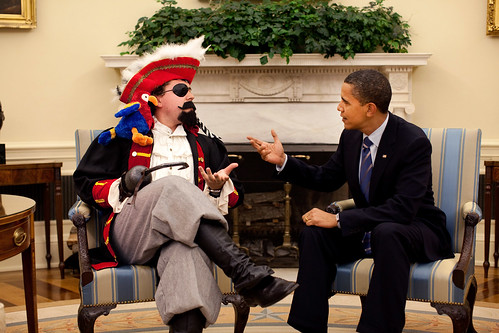
Some may dismiss this as cute, but would it be as funny to have the President joke around with someone in a comical KKK robe, terrorist headrag or urban thug paraphenilia?
If not, then why can we laugh about pirates for aren't they simply carjackers or street gangs of the high seas?
I wonder if victims of pirates would like the President being so light-hearted about the tragedy that befell them.
But I guess since the pirates are teenage Africans (one of Obama's prime voting blocs), we should just overlook it all.
Technically, by definition, wouldn't he be more "African" than all the Black students at the school put together? And as a public school where evolution is taught, since evolutionary anthropology contends we all came from Africa to begin with, shouldn't every student (White or Black) be eligible for this recognition?
Some traditions should be so hallowed that they should not be sullied by political controversies or used as a vehicle to manipulate the participants into embracing perspectives and policies they might not otherwise be exposed to or willing to accept. As a celebration of profound cultural significance at one of America's most solemn and historic venues, the annual Easter Egg Roll at the White House ought to be just such an occasion.
Unfortunately, not even this event gets to remain one where kids and families can have a day of fun without being bombarded by a litany of questionable values. Ironically, the ones that ought to be the most vigilant about protecting the event's integrity are among those most eager to see it bastardized.
To the average American mired in outdated notions such as individuality and privacy, one would think tickets to this event would go to the first to apply for them irrespective of attributes such as race, creed, or sexual preference. However, to the Obama administration, who you like to roll around in the bedroom with should be one of the factors considered to determine whether or not your child is worthy of rolling eggs on the White House lawn.
According to an Associated Press story posted at Boston.com titled "White House Invites Gay Families To Easter Event", the Obama Administration set aside and funneled a percentage of the tickets to Sodomite front groups such as the Human Rights Campaign and the National Gay & Lesbian Task Force. The executive director of the Family Equality Counsel said in the article, "The Obama administration actually reached out to us as an organization and said we want gay families there, and they are an important part of the American family fabric."
It is not so much that gay people want to attend the Egg Roll and have been barred in the past as gays have participated in years past. Rather, it is now they not only want to tell everybody about it but also for authorities to fawn all over them.
Are those mired in this brand of sin so guilt-ridden that they cannot simply attend this event quietly in support of the children without having to blab about their personal kinks? If a family of polygamist breakaway Mormons showed up at the Egg Roll, should White House staff ooh and ahh over them as "an important part of the American family fabric" as not all participating in this deviancy are child molesters like in the Warren Jeffs cult.
Though the attention of those interested in these kinds of cultural battles will be focused primarily on this skirmish as to what constitutes a family, this was not the only ideological struggle taking place at the White House Egg Roll. Though less likely to garnish headlines, the information families were exposed to at the event no doubt nudged many in the direction of increasing how much government control and influence they would allow over their lives.
The theme of the 2009 Egg Roll was "Let's go play". In pursuit of this policy, children were encouraged to live healthy and active lifestyles complete with cooking demonstrations (I wonder if any of the St. Louis pizza chefs flown into the White House to appease our New Lord were on hand). No doubt, much of these efforts are to get the youth fit for Fuehrer Obama's proposed mandatory service programs and work camps.
At least in regards to homosexuals infiltrating the White House Egg Roll, the Associated Press Article observed, "Some conservatives accused gays and lesbians of trying to crash the event and turn it into a forum for ideological politiciking."
Some might conclude unseemly forms of propaganda were not allowed to sully the innocence of the Egg Roll before the reign of Barack The First was unleashed upon the American taxpayer. Frankly, I heard about it last year as well under the regime of George W. Bush but didn't get around to writing about it in a timely manner as (at least until Obama pulls the plug on the Internet which is being considered in a variety of ways in the name of special emergency executive orders, the fairness doctrine, and now even online civility) a blogger's work is never done.
The theme of the 2008 Egg Roll was ocean conservation. Frankly, other than an hard boiled egg tasting good with a pinch of salt sprinkled on it, what does the ocean have to do with an Egg Roll?
This propaganda went beyond having a nifty touchtank on hand with a horseshoe crab crawling around inside. The White House declared, "Through education and volunteerism, all families can make a difference in keeping our oceans clean."
Seems, when being brainwashed, it's not simply enough to dutifully assimilate the material our keepers expect us to. We must also pledge ourselves to manually labor without remuneration.
More importantly, we are also reminded by this story that the manipulation of the American people into indentured servitude was not something sprung upon us totally with the election of Barack Obama. Rather the erosion of liberty has been slowly put into place over a succession of presidential administrations and getting to the point where many no longer notice the noose tightening around our necks or actually have grown to accept it as a comforting embrace.
There is no reason whatsoever why an egg roll must have a theme other than being an egg roll. If the American people allow the state to draw the focus away from the higher truths these celebrations were established to commemorate in favor of extraneous policies and propaganda, eventually the state will take the place of the One
such festivities were originally intended to honor.









.jpg)